I’m Lone Crane, from Actual Wuxia Translations and Wuxia Wanderings. I was updating the links to my English translations list (so many broken after spcnet shut down), and so of course I ended up here among other places and got to looking around, and I was dismayed (and annoyed) to find a lot of incorrect information in what appears very strongly to be AI-generated articles.

I wonder how much actual research is taking place? Because some of the inaccurate information I’ve come across is a bit baffling. For example, on the Meet the Wuxia Authors blog entry, it lists Shangguan Ding as a “politician turned wuxia novelist”, but that is not correct. Shangguan Ding was three brothers who began writing wuxia when they were teenagers in the early 1960s so that they could save up money to buy an air rifle. Later they went off to university on their separate ways, One of the brothers, Liu Zhaoxuan, became a politician. Then in 2014, he wrote another wuxia novel, this time on his own.He didn’t start out as a politician and then become an author. He was already an author as a teenager. Now the Shangguan Ding wiki page has this information, so it’s odd that the blog entry gets it wrong. Unless it were AI-generated.
On that same page it lists Cheng Tiewu under the “Hong Kong School” of writers. But Cheng Tiewu was a Taiwan author! He came to Taiwan during the civil war, as so many wuxia authors did. His wiki article on here also gets the info wrong and doesn’t even include his real name. Check out this paragraph and tell me it’s not AI-generated:
Details of Cheng Tiewu’s early life remain scarce, a common fate for many wuxia authors of his generation who wrote under pseudonyms or received limited biographical documentation. What is known derives primarily from publication records and contemporary accounts of the Hong Kong wuxia scene.
For actual information about Cheng Tiewu, see Lin Baochun’s book History of Taiwan Wuxia Fiction 台灣武俠小說史, volume 1, pgs. 75-85.
The inclusion of an entry for Yuwen Yaoji is interesting. Why include him at all? He was not a significant author. I guess because he did some ghostwriting for Wolong Sheng? But his wiki page is the best evidence that these articles are simply AI-generated. Because there is actually not a lot known about this author, which the wiki article does state, repeatedly. But notice how long the article is and how little information there actually is.
Take this paragraph for instance:
Yuwen Yaoji’s works embrace traditional conventions: martial arts mastery (frequent sword and blade references), jianghu settings, heroic archetypes (wandering xia, compassionate heroes), and numerical frameworks (Three Heroes, Twelve Fiends, Twin Manuals).
Does that sound like it was written by a human being who was familiar with the author’s work? The page is full of writing like that.
There’s also a reference link at the bottom of the page to Yuwen Yaoji’s Chinese Wikipedia page, except such a page does not exist! A human being writing this page would not include a reference link that doesn’t exist. Clearly this whole page appears to be AI-generated.
The other reference link on that page is a link to a digital archive of his work, but it’s a pirated page. I doubt the site owner here was aware of that, but I want to mention it because I actually had a hand in this matter. I’m one of the people who scanned, OCRed, and proofread Yuwen Yaoji’s books and uploaded them online. I worked on his debut novel, 幽冥谷, scanning the pages of my copy of the book, running it through OCR software, then proofreading it to correct typos and other mistakes before uploading it to the Chinese Gu Long forum where most of the scan/OCR/proofreading work goes on. Much of the wuxia content available for people to read online is the work of those of us at the forum there. You can see my original posting for that novel here. The proper digital archive link for Yuwen Yaoji is here, at the Gu Long forums site. The author photo on that page, and on the pirated site, was one I found after trawling through Singapore newspapers and uploaded. I posted that picture on my forum post along with a preliminary bibliography of Yuwen Yaoji’s work (Sorry, as a new user I can only post two links here).
The point of me tooting my horn like this is to emphasize that there are people doing real work sharing wuxia novels, researching author bibliographies, correcting typos, etc. So it’s frustrating to see misinformation lazily being spread online.
The Yun Zhongyue wiki page also has problems. He’s my favorite wuxia author, I even had an officially licensed translation of one of them (Song of Exile) some years back, thanks to contacting one of his daughters. But the information on the wiki page here does not seem like it came from a fan, or even someone reporting on existing research.
For example, under Literary Style:
His protagonists often possess intelligence-gathering abilities complementing martial skills. Tactical positioning, reconnaissance, and strategic planning feature prominently.
Huh? His novels do not feature “tactical positioning”, wtf. A human being did not write that paragraph. More troubling, some of the works listed for him are not accurate:
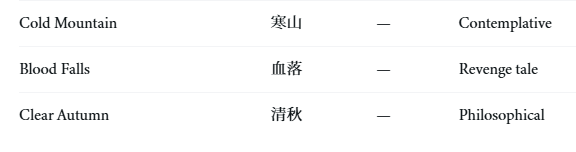
None of those three novels are real Yun Zhongyue works!
The Wolong Sheng page also has some issues. Some of the dates are wrong, for example Wolong Sheng’s novel Soaring Swallows Startle Dragons (aka Flying Swallow Startles the Dragon) is listed as 1959. It should be 1958 (1958.08.16—1961.07.08 to be precise). I have a full bibliography for Wolong Sheng if anyone wants to consult it.(Again, sorry, can’t post the link).
Under Style Evolution:
In 1965, Wolong Sheng began experimenting with a “semi-traditional, semi-modern” approach, incorporating detective fiction elements and psychological suspense. Works from this period — Heavenly Perfume Storm, Red Snow, Black Frost, Nameless Flute — displayed darker themes and more ambiguous moral territory.
The problem here is, all three of the novels listed there were published before 1965. All of them in 1961, in fact. This here seems like an AI hallucination.
In the description of Jade Hairpin Oath:
Xu Yuanping, driven by blood feud, searches for the “Forbidden Palace Key”.
This is incorrect. Jade Hairpin Oath has nothing to do with a Forbidden Palace Key 禁宮之鑰. That item is from the next novel down on the wiki page, Golden Sword, Eagle Feathers. Jade Hairpin Oath mostly takes place in a tomb. Again, this has to be another AI hallucination. These are the dangers of using AI to do your work for you.
Further down, Red Snow, Black Frost is listed as 1965, but that’s wrong, and odd. No information sources I’m aware of list it as 1965. Maybe I missed one. Everywhere I’ve seen has it listed as 1963, which incidentally is also incorrect. My own research into this a few years ago found that novel to originally to have been published in 1961. But 1963 was the date wuxia scholars had for it before that (I don’t know where that date came from). 1965 I suppose is another hallucination.
Elsewhere the martial arts manual in Flying Swallow Startles the Dragon is named as Guanyin Secret Manual. That’s incorrect. The manual is 歸元秘笈 (Guiyuan Miji), that is, Return to the Origin Secret Manual. Again it looks like an AI hallucination.
I’ll stop there. It’s one thing to try your best and still make mistakes. We all do that. But to just have AI put together content for you, and not even verify it, is not a good way to go about it. It just leads to wrong information being propogated. When you have these wiki articles that sound so authoritative, naturally people will believe what they read. We ought to do our best by the wuxia community to make sure the information we share is as accurate as we can make it.